


Optimize Operations & Maintenance
Discover OMS features that enhance efficiency, improve asset management, and streamline maintenance processes.

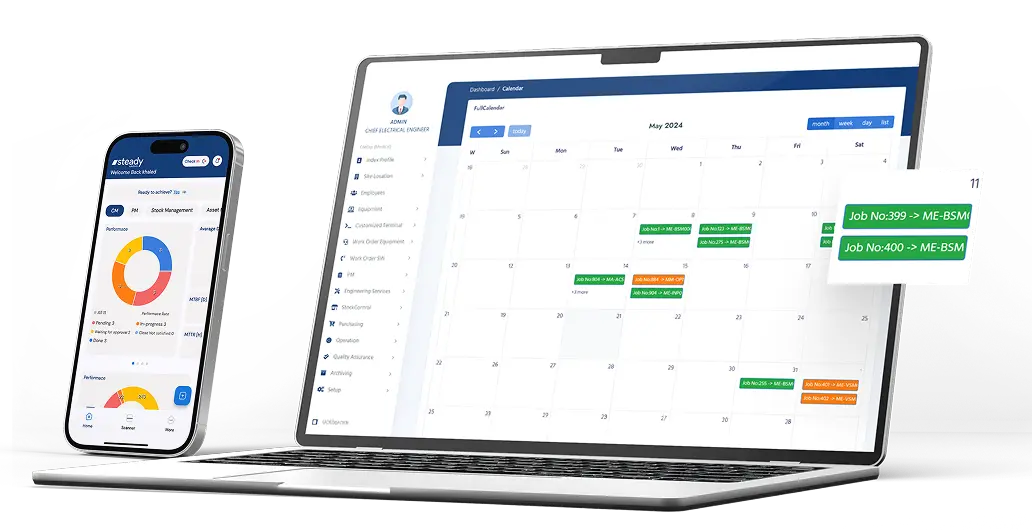






























Metrics & KPIs
Inpatient Flow
Tracks patient movement, resource utilization, and care quality in a hospital, focusing on efficiency, safety, and outcomes.

01 Total Admissions
Total number of patients admitted to the hospital.
02 Bed Turnover
Frequency at which a bed becomes available and is filled again.
03 Readmission Rate
Percentage of patients readmitted within a specific time frame after discharge.
04 Average Length of Stay
Average number of days a patient stays in the hospital.
05 Discharge Process Time
Time taken to complete the discharge process.
06 Emergency Number of Visits
Total number of emergency department visits.
07 Average Cost per Discharge
Average expense incurred for each discharged patient.
08 Patient Satisfaction
Measure of how satisfied patients are with their care.
09 Infection Rates
Number of hospital-acquired infections per patient population.
10 Failure to Rescue
Inability to prevent death after a complication.
11 Incidence of Falls
Rate of patient falls occurring during their stay.
12 Harm Events & Accidents
Number of harmful incidents or accidents involving patients.
13 Mortality Rate
Percentage of deaths among the patient population.
14 Occupancy Rate
Percentage of hospital beds currently occupied by patients.
15 Patient-to-Staff Ratio
Number of patients assigned per healthcare staff member.
Sales
Measures sales efficiency, pipeline performance, order conversions, sales growth, and target achievement.

01 Lead Response Time
Time taken to respond to a sales lead.
02 Total Pipeline Value
Total value of all potential sales opportunities.
03 Opportunity-to-Order %
Ratio of opportunities that convert into orders.
04 Average Order Value
The average monetary value of each order.
05 Average Sales Cycle Time
Average time to close a sale from lead to order.
06 Sales Volume by Location
Total sales grouped by geographical areas.
07 Sales Target %
Percentage of achieved sales compared to the target.
08 Sales Change (Y/Y, Q/Q, M/M)
Growth or decline in sales over time (yearly, quarterly, monthly).
Managers
Evaluates managerial performance through customer satisfaction, sales, profitability, and employee productivity.

01 Customer Satisfaction Score
Measure of how satisfied customers are with a product/service.
02 Sales by Product or Service
Breakdown of sales by individual products or services.
03 Revenue per FTE
Revenue generated per full-time employee (same as HR metric).
04 Revenue per Customer
Average revenue generated from each customer.
05 Operating Margin
Profit generated from operations before tax and interest.
06 Gross Margin
Difference between sales and cost of goods sold.
07 Debt to Equity Ratio
A measure of company’s financial leverage.
08 Working Capital
Difference between current assets and current liabilities.
09 Employee Satisfaction Rating
Rating of employee happiness (same as HR metric).
Human Resources
Monitors workforce health, employee satisfaction, turnover, training efficiency, and hiring practices.

01 Absenteeism Rate
Percentage of employees absent during a specific period.
02 Employee Satisfaction Rates
Measure of overall employee happiness and satisfaction.
03 Average Age of Workforce
The average age of employees in the company.
04 Training ROI
Return on investment for employee training programs.
05 Labor Cost per FTE
Average cost of labor per full-time employee.
06 Revenue per FTE
Total revenue generated per full-time employee.
07 Vacancy Rate
Percentage of unfilled positions in the company.
08 Resignation/Retirement Rate
Rate at which employees leave or retire.
09 Gender Hire Ratio
Proportion of male to female hires.
10 Talent Import/Export Ratio
Percentage of new hires sourced externally.
11 Voluntary Turnover Rate
Percentage of employees who leave voluntarily.
12 Retention Rate
Percentage of employees who stay over a period.
13 Retirement Rate Forecast
Predicted rate of upcoming retirements.
14 Internal vs. External Training Ratio
Balance between internal and external training sources.
15 Average Training Hours per FTE
Average hours spent in training per full-time employee.
16 Average Training Costs per Employee
Average cost spent on training per employee.
Financing
Tracks financial health, liquidity, profitability, cash flow, and resource utilization across the company.
01 Accounts Receivable
Money owed to the company by customers.
02 Accounts Payable
Money the company owes to suppliers.
03 Total Operating Margin
Operating income as a percentage of revenue.
04 Gross Profit Margin
Profit after the cost of goods sold, expressed as a percentage of revenue.
05 Net Profit Margin
Profit after all expenses, expressed as a percentage of revenue.
06 Working Capital
Measure of a company’s operational liquidity (same as in Managers).
07 Current Ratio
Ratio of current assets to current liabilities.
08 Quick Ratio
A stricter version of current ratio, excluding inventory.
09 Debt-to-Equity Ratio
Ratio of total liabilities to shareholders’ equity (same as in Managers).
10 Inventory Turnover
How quickly inventory is sold and replaced.
11 Total Asset Turnover
How efficiently a company uses its assets to generate sales.
12 Return on Equity
Profit generated from shareholders’ equity.
13 Return on Assets
Profit generated from the company’s assets.
14 Operating Cash Flow
Cash generated from regular business operations.
15 Cash Collected vs. Target
Amount of cash collected compared to the target amount.
16 Cash Receipt to Bad Debt
Ratio of cash received compared to uncollectable debts.
17 Days of Cash on Hand
Days the company can operate with available cash.
18 Fixed Asset Turnover
How efficiently fixed assets are used to generate revenue.
19 Long-Term Debt
Amount of debt due in more than one year.
20 Total Salary per FTE & Overtime Costs
Salary and overtime expenses per full-time employee.
CRM
Measures customer service efficiency, issue resolution, response times, customer satisfaction, and employee involvement.

01 Number of Issues (By Type)
Total customer issues, categorized by type or problem.
02 First Response Time (FRT)
Time taken to respond to a customer’s initial inquiry.
03 Average Response Time
Average time to respond to customer queries or concerns.
04 Net Promoter Score (NPS)
Measures customer loyalty and satisfaction based on likelihood to recommend.
05 Employee Engagement
Assesses how engaged and motivated employees are in their roles and tasks.
Quality Control
Monitors adherence to quality standards, user errors, and equipment failures.

01 Manage QA Criteria
Monitors adherence to quality assurance standards across operations.
02 User Errors
Tracks the number of errors caused by operators during equipment usage.
03 Incidents Related to Equipment
Records and analyzes equipment-related incidents.
04 Revenue per Customer
Average revenue generated from each customer.
05 Misused
Tracks instances of improper equipment use, leading to potential damage.
06 DT vs. Throughput (TP)
Compares equipment downtime against productivity levels.
07 Due PM Failure
Measures the impact of failed preventive maintenance activities.
08 Number of Failures per Equipment
Tracks the frequency of failures for each piece of equipment.
Maintenance
Tracks equipment uptime, preventive maintenance, and maintenance costs versus equipment value.

01 Max, Min, and Average Downtime (DT)
Measures the maximum, minimum, and average time equipment is out of operation.
02 PM Performance Meter
Tracks the effectiveness of preventive maintenance activities in preventing breakdowns.
03 MEL (Maintenance Event Log)
Records all maintenance events, tracking repairs and service history.
04 MTBF (Mean Time Between Failures)
Measures the average time equipment operates between failures.
05 Manpower Load
Tracks the distribution of maintenance tasks among the workforce.
06 Maintenance vs. Equipment Cost
Compares maintenance costs against the overall cost of equipment.
Priorities and Safety
Prioritizes tasks, tracks risk factors, and ensures operational safety.

01 Class
Categorizes tasks and issues by priority levels.
02 WOP (Work Order Priority)
Assigns priority levels to work orders based on urgency.
03 Tolerance Period
Tracks the acceptable delay period before a task becomes overdue.
04 Risk Factor, Power Load
Assesses risk levels and power consumption in operations.
Projects
Measures project timelines, budget adherence, resource utilization, and customer satisfaction.

01 On-Time Completion %
Measures the percentage of projects completed on or before the deadline.
02 Estimate to Project Completion
Tracks the time remaining until project completion.
03 Planned vs. Actual Hours
Compares scheduled hours against actual hours worked.
04 Resource Capacity %
Monitors the percentage of available resources currently utilized.
05 Budget Variance (Planned vs Actual)
Compares planned project costs against actual spending.
06 Net Promoter Score
Measures customer satisfaction and loyalty based on feedback.
07 Number of Errors
Tracks errors encountered during the project.
08 Customer Complaints
Records and analyzes customer complaints to improve services.
Purchasing & Procurement
Tracks procurement efficiency, on-time delivery, cost savings, and supplier performance.

01 On-Time Delivery
Measures the percentage of deliveries received on or before the expected date.
02 Cycle Time
Tracks the total time taken from placing an order to receiving goods.
03 Incidents Related to Equipment
Records and analyzes equipment-related incidents.
04 Purchase Price Variance
Measures the difference between the expected and actual cost of purchases.
05 Supplier Lead Time
Tracks the time taken by suppliers to fulfill orders.
06 Rejected Items %
Monitors the percentage of goods rejected upon delivery.
07 Employee Learning
Tracks the training and development of procurement staff.
08 Cost Saving
Measures cost reductions achieved through procurement activities.
Operation Management
Monitors contract performance, budget adherence, supply chain efficiency, and risks.
01 Operating Contracts
Monitors the status and performance of contracts with clients.
02 Contracts Budget
Tracks budget adherence for ongoing contracts.
03 Supply Chain, Inventory
Monitors the flow of supplies and inventory levels.
04 High Risk
Identifies high-risk areas that need closer management.
05 Sites Dashboard
Centralizes data on various operational sites for quick analysis.
Benchmarking
Compares internal and external performance against industry standards for improvement.

01 Black, White, or Grey
Categorizes service providers or internal employees based on performance criteria.
02 Repair, PM
Compares repair activities against preventive maintenance efforts.
03 Employee
Benchmarks employee performance against set standards.
04 Service Provider
Evaluates the performance of external service providers.
Warehouse Management
Optimizes inventory processes, supplier performance, and warehouse utilization.

01 Labor Utilization
Measures the precision of inventory records compared to actual stock.
02 Order Cycle Time
Tracks the time taken from order placement to delivery.
03 Order Picking Accuracy
ReMeasures the accuracy of picking the correct items for customer orders.cords and analyzes equipment-related incidents.
04 Rate of Return
Tracks the percentage of goods returned by customers.
05 Warehouse Capacity Utilization
Monitors how effectively warehouse space is utilized.
06 Stock-Out Rate (Re-order Level)
Measures the frequency of inventory stock-outs.
07 Number of Suppliers
Number of Suppliers
08 Supplier Defect Rate
Monitors the percentage of defective goods received from suppliers.
09 Supplier Quality (Evaluation) Rating
Rates supplier performance based on quality metrics.
10 Emergency Purchase Ratio
Tracks the frequency of emergency purchases due to inventory shortages.
11 Inventory Turnover
Measures the rate at which inventory is sold or used.
12 Inventory Obsolescence (Risk)
Monitors the risk of inventory becoming obsolete and unsellable.
Cost Management
Tracks asset costs, repair expenses, labor costs, and revenue growth.

01 Asset Cost
Tracks the cost of acquiring and maintaining assets.
02 Depreciated Value
Monitors the decrease in asset value over time.
03 Manpower
Measures labor costs associated with maintenance and operations.
04 Repair Cost
Tracks costs incurred from repairing equipment.
05 PM Cost
Measures costs related to preventive maintenance activities.
06 Parts Consumption
Monitors the rate at which spare parts are used in operations
07 Revenue Growth
Tracks the increase in revenue over time.
MOBILE
APPLICATION
(Members Only)
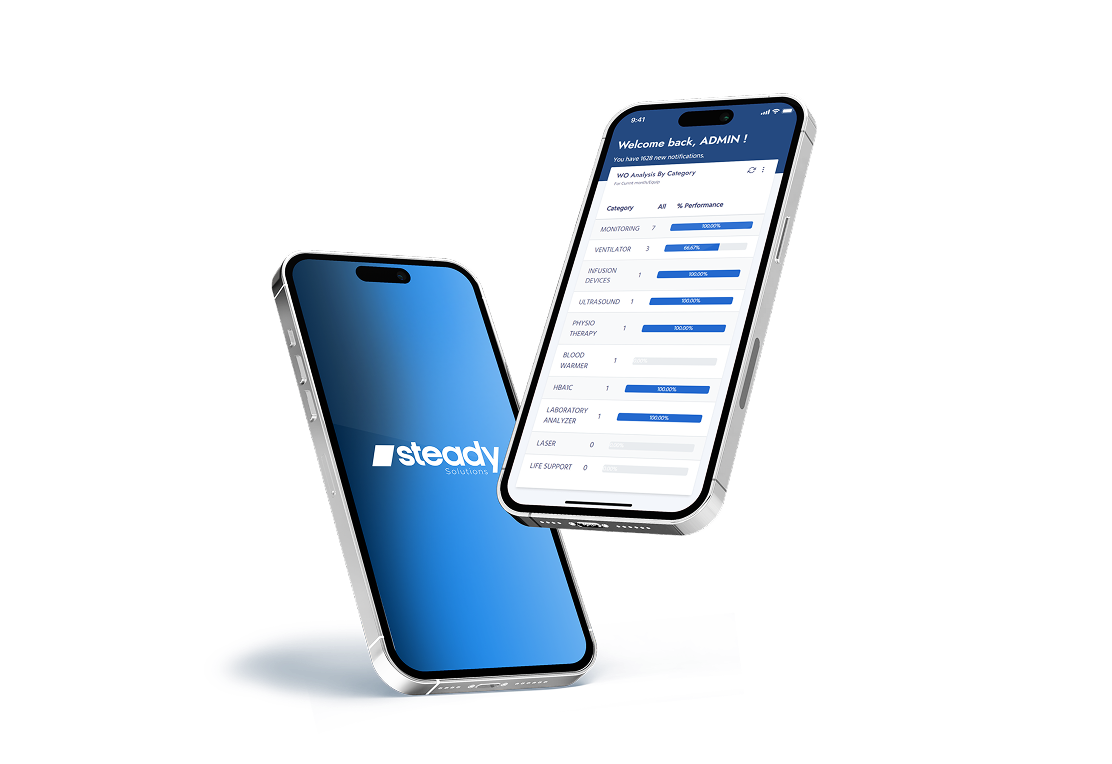
With our mobile application, your team can access real-time data, monitor assets, and manage tasks no matter where they are.
From work orders to maintenance tracking, the Steady mobile app ensures your operations are always under control.



to explore system features
Download
our catalog
and use cases across OMS, ERP, and HIS.
